Khlestakov–Governor mistaken-identity relationship
The Government InspectorThe mistaken-identity relationship between Khlestakov and Anton Antonovich Skvoznik-Dmukhanovsky turns a frightened local official’s expectation of inspection into a comedy of misplaced authority. The Governor sees a powerful agent of the capital where there is only a stranded traveler; Khlestakov, by contrast, initially sees a chance to borrow money and escape an unpaid inn bill. Their unequal understanding of the encounter lets each interpret the other’s behavior in a way that intensifies the error, until a letter reveals what Khlestakov himself thought had happened.
Warning and Misidentification
The Governor’s fear begins with news of an inspector from Saint Petersburg, traveling incognito and carrying secret instructions. A letter from Andrei Ivanovich warns that an official has arrived to inspect the government, especially the local district. The possibility of a concealed investigator makes ordinary signs seem ominous: the Governor even recalls dreaming of two enormous black rats before reading the warning. He is also concerned that merchants and townspeople dislike him and wonders whether they have denounced him. Seeking control over what the capital might learn, he asks Ivan Kuzmich Shpekin to open letters passing through the post office and look for information against him.
The mistaken identification comes through Piotr Ivanovich Bobchinsky and Piotr Ivanovich Dobchinsky. At the inn, they learn that Khlestakov is a government official from Saint Petersburg, has been there into his second week, rarely leaves his room, and has not paid his bill. He has a postchaise ordered for Saratov. These details describe a stranded traveler, but the brothers connect them to the anticipated inspection. Bobchinsky’s account of Khlestakov’s appearance and manner becomes part of the case: he recalls feeling that the young man was no ordinary person. When they identify the guest as the expected inspector, the Governor’s alarm overrides the possibility that they have mistaken an ordinary official for a powerful visitor.
The Inn Encounter and the Loan
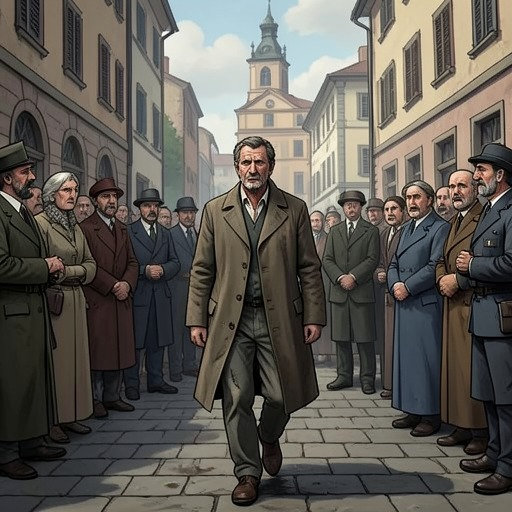
When Anton Antonovich Skvoznik-Dmukhanovsky meets Khlestakov, the first exchange gives the audience a clear view of their incompatible expectations. The Governor advances, stops, and stares at him in frightened silence before recovering enough to salute and offer his compliments. Khlestakov, however, is preoccupied with the debt that has kept him at the inn. He halts at first, then insists that he means to pay when money arrives from home. The Governor’s formal deference meets a man thinking about his bill, not an inspector concealing his authority.
The Governor nonetheless reads Khlestakov’s uncertainty as deliberate guile. Believing that the supposed inspector is speaking indirectly, he offers assistance as a duty owed to a stranger. Khlestakov directly asks to borrow two hundred rubles, adding that even less would do, so that he can settle with the innkeeper. The Governor gives him the requested sum. The same exchange therefore carries two meanings: for Khlestakov it is a practical loan, while for the Governor it confirms the anxious logic of his mistaken encounter. Khlestakov’s promise to repay when money comes from home does not dislodge that assumption.
The Governor then presents his visit as a routine act of public service. He claims to have come with Piotr Ivanovich Dobchinsky to check that guests are properly accommodated, insists that he differs from governors who neglect their duties, and describes his concern as Christian philanthropy. The performance lets him treat the encounter as though he knows who his visitor is while pretending not to know. Khlestakov accepts the hospitality in the simpler terms available to him: without the Governor’s help, he says, he would have had to remain at the inn because he could not pay his bill.
Authority Imagined and Performed
The error grows because the Governor interprets not only Khlestakov’s presence but also the hospitality offered to him through the imagined inspection. In defending the town’s institutions, he claims that its officials care above all about earning the Government’s esteem through order, vigilance, and efficiency. That claim sits beside his earlier efforts to manage appearances and control what people might report. His relationship with Khlestakov thus exposes a gap between official self-presentation and conduct: the Governor speaks in the language of administrative virtue while acting under the pressure of possible scrutiny.
Khlestakov’s increasingly extravagant boasts deepen the gap between what the Governor believes and what is actually before him. Khlestakov describes lavish meals, including a watermelon costing seven hundred rubles, and claims to mix with ministers and foreign ambassadors. He then tells of becoming head of a department after its director disappeared, saying that thirty-five thousand couriers arrived to ask him to take the position. In his account, he accepts while still in a dressing-gown and makes the offices tremble when he inspects them. The Governor and the other officials rise in awe and tremble as Khlestakov works himself up. The scene makes the mistaken relationship visible in bodies as well as words: Khlestakov’s invention expands, and the Governor’s deference answers it as if it were a report from the center of imperial power.
That imagined connection reaches beyond the immediate encounter. After Khlestakov has left, the Governor asks Anna Andreyevna whether, because Khlestakov is close to the ministers and visits the court, he might rise to a high rank and become a general. His question shows that he has converted the supposed inspector’s invented prestige into a prospect for his own advancement. Khlestakov is no longer merely a visitor whose favor must be secured; in the Governor’s expectations, he is a route to promotion and a transformed position within the hierarchy.
Exposure and Reversal
The relationship collapses when Shpekin rushes in holding an unsealed letter and announces that the official they took for an inspector is not one. Reading Khlestakov’s letter to a friend, Shpekin reveals a radically different account of events. Khlestakov writes that an infantry captain took his last penny, that the innkeeper then wanted to send him to jail, and that the town mistook him for a governor-general because of his Saint Petersburg appearance and clothes. He describes staying at the Governor’s home, flirting with the Governor’s wife and daughter, and receiving all the money he wants from the local officials. What the Governor had read as calculated authority, Khlestakov describes as fortunate rescue and comic entertainment.
The letter does more than correct Khlestakov’s title. It exposes the distance between the two men’s accounts of their relationship: the Governor has treated the traveler’s supposed access to the state as a danger and then as an opportunity, while Khlestakov has understood the town’s response as a windfall. On hearing the disclosure, the Governor says that Khlestakov has cut his throat and that he is finished; he says that he sees pig snouts instead of faces and calls for Khlestakov to be caught. His frantic response cannot restore the authority he believed he was negotiating with. The reversal leaves him confronted not by the inspector he feared, but by the consequences of his own credulity and the conduct he tried to shield from scrutiny.